

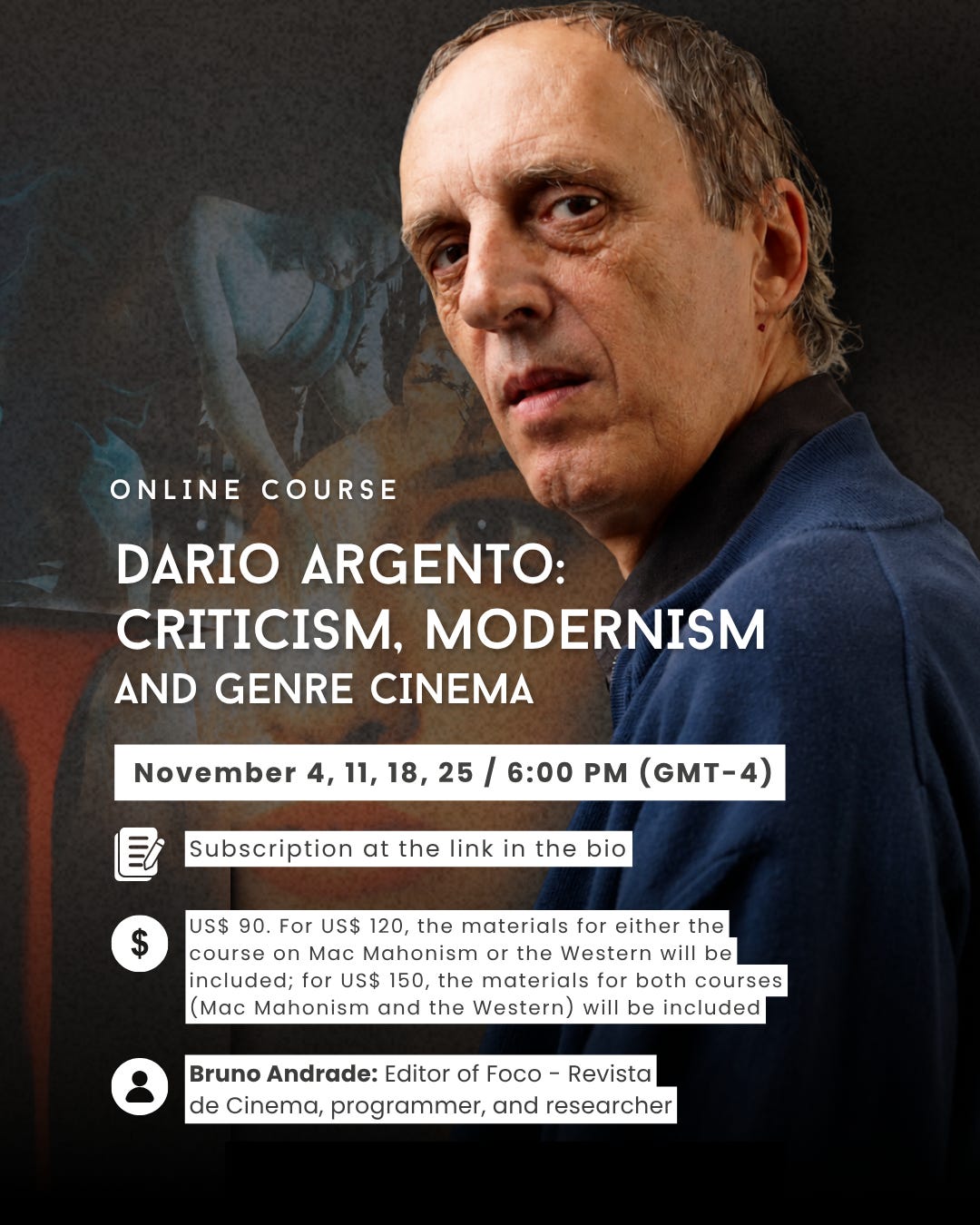
E, para quem ainda não se inscreveu aqui no Brasil (o curso começa no dia 07 de outubro), a ficha de inscrição.
In Rome, I used to go to the Filmstudio. It was a very exciting place for a film enthusiast. I saw everything there. German cinema, French cinema... Russian cinema too, which I was passionate about. Dziga Vertov, Kino-Eye. And Eisenstein, fascinating.
One of the things that impressed me the most, apart from the horror film series at the Metropolitan, apart from Hitchcock and Visconti, was Vertov’s Kino-Pravda. The story is pure adventure, action in its purest form. With very simple means, it manages to communicate very profound visual emotions.
It was difficult to see Andy Warhol’s films in Italy. I could only see them later, with the exception of Empire, which I saw when it was released. It is one of the fundamental films of my life. They programmed it at one edition of the Pesaro Film Festival; I don’t remember exactly which year, but it was in the second half of the 1960s. I went because there were many avant-garde films that were impossible to see in ordinary cinemas. So there I was, watching a Warhol film for the first time. The camera is fixed, framing the Empire State Building in New York. It was like a dream.
(...)
If you don’t allow yourself to be conditioned by ideology and try to start thinking things through, even if you are very young, if you are a 15- or 18-year-old boy, you will understand things instinctively. On one side there is a propaganda product, sad, dark, false films, a kind of empire of evil; on the other side there is Disneyland, the prairies, Hitchcock, mystery, adventure, enchantment and wonder. And also the supernatural, science fiction, vampires. Christopher Lee with blood around his mouth. That red, those saturated and violent colors. Powerful images, dreams... It is a real difference, something you can feel in your bones. Something very simple and immediate.
“Argento parla,” interview conducted by Daniele Costantini and Francesco Dal Bosco, Nuovo cinema inferno. L’opera di Dario Argento. Pratiche Editrice: Milan, 1997.
Interview with Dario Argento, October 26, 1975 (“L’Ospite delle 2”):
Luciano Rispoli: Dario Argento, you are a giallo filmmaker...
Ennio Ceccarini: I would say a thriller filmmaker.
Luciano Rispoli: Ah, a thriller? Is there a difference?
Dario Argento: There are significant differences, because many genres come together in the giallo... Because everything stems from a very old misunderstanding that emerged in the 1930s: in Italy, there was a series of books with yellow covers (“giallo” in Italian), and these books were mystery stories, of the “who is the murderer?” variety, stories of suspense. And at the time these books were called gialli. In France, for example, they were called noirs, because the same series of books had black covers. In reality, the giallo can bring together many branches of the action film: from the police film to mystery, and then...
Luciano Rispoli: We can try to subdivide these strands, if possible, with the help of Daria Nicolodi and Ennio Ceccarini. So, what are the major strands into which we, as people knowledgeable about cinema, can place the giallo film?
Dario Argento: This category of action film encompasses, on the one hand, the police or gangster film. Then there is mystery, which represents the rational mechanism that comes from the English novel, from Agatha Christie, or from the American novel, from Van Dine. In other words: who is the murderer, and a whole series of investigations. After mystery, I would mention the thriller, which is also a strand within this genre, but has very particular characteristics. The thriller is more concerned with tensions and emotions, and it involves great formal attention to the timing and pacing of narrative episodes. Then there is the spy story... No, actually, horror...
Luciano Rispoli: Let us say something about these two strands. The spy story — what is it?
Ennio Ceccarini: The spy story is a strand with very important literary antecedents. We could mention some of Conrad’s works, or W. Somerset Maugham. The spy story is the story of great secret agents. I would say that, despite having such important literary origins, the spy story has triumphed in recent times precisely because it represents the new figure of the detective who protects a certain international order. So, I wasn’t going to mention it, but there is the case of 007, James Bond. The most famous example, however, remains The Spy Who Came in from the Cold, by John le Carré, and the anonymous heroes of Len Deighton. And, of course, there is the other, more sarcastic side of the coin: Agent Flint, Our Man in Havana, and so on.
Luciano Rispoli: And what about horror?
Dario Argento: In horror, we can include films adapted from the masterpieces of Gothic literature... Frankenstein... It seems to me that The Monk — I don’t know whether they ever made a film based on The Monk... In any case: Dracula, The Mummy, and all the rest.
Luciano Rispoli: Perhaps we owe our viewers an explanation as to why we chose a sequence from this Fritz Lang film, Dr. Mabuse, to open our conversation about the giallo in cinema. Because Lang is perhaps the first, and if not the first, the most important among the early...
Dario Argento: Well, Lang came out of the great Expressionist tradition, and he made a film that brought together... We saw a sequence, a beautiful sequence in a car, sensational, one of the most beautiful things... Alongside him, some years earlier, some years later, and contemporaneously, there was D. W. Griffith in the United States, who was already experimenting with these techniques... Because suspense is an eminently cinematic genre. This means that it is difficult to express suspense on the page. Therefore, suspense novels are also rare, because they are composed through an editing of time, mechanisms, and situations that need to be captured by the camera — in other words, it is highly subjective, rather than objective. In the sense that it is not the event itself that matters, but rather how the event is represented. So: that is suspense, and that is also emotion.
Luciano Rispoli: So, this sequence is an example of suspense, I believe...
Dario Argento: It’s a jewel. A perfect mechanism.
L.R.: The viewers recently saw Dial M for Murder on television, so perhaps we can talk about it. Did you see it, Daria?
Daria Nicolodi: I saw it for the first time on television when it was broadcast.
L.R.: And did you like it?
D.N.: I thought it was beautiful.
L.R.: Here we witness the first moment of a crime. But, in reality, the victim will not be...
D.A.: The intended victim — but it is the murderer who will ultimately become the victim.
L.R.: The one who, up to the point we have seen, was supposed to be the actual murderer.
D.A.: And yet...
L.R.: The person who ordered the crime was...
D.A.: The husband.
L.R.: The husband, on the telephone.
D.A.: You have to pay attention to the timing, the way Hitchcock works with time, which is sensational, brilliant. There is also another treatment of time at the end of the film. It is really a meticulously planned film.
L.R.: So, as experts, satisfy our curiosity.
D.A.: Did you notice all the mishaps?
L.R.: The husband was the instigator of the crime, and he was in a restaurant. He looks at his watch, and it is broken.
D.A.: It has stopped, yes.
L.R.: So, the first accident, within a very short period of time.
D.A.: Then there is this gentleman on the telephone, and he cannot get through.
L.R.: Because he was supposed to direct the crime by telephone, from a distance, and the telephone booth is occupied.
D.A.: When he calls, the hired killer is about to leave, and he risks running into the wife, who is arriving. In short, it is a truly perfect film.
L.R.: What is this an example of? Suspense, or what?
D.A.: Of working with time. Suspense is created through time, through narrative timing. I believe that it was through this that suspense evolved in cinema, precisely because it allows the filmmaker to study all kinds of real time, invented time... In other words, for Hitchcock, the story is not what matters. Not very much, at least. What matters more to him are the conflicts.
L.R.: But the story is constructed, it seems to me, with extreme clarity.
D.A.: It is a perfect story. And notice how, during the telephone call, we see the mechanism of the telephone making that clicking sound. Hitchcock places this story within his own singular universe — a universe of sinister events and mishaps, an unsettling and dangerous universe. In fact, the ending brings another fantastic moment, the one with the key. The villain, Ray Milland, returns and finds the key, but hesitates and begins to explain the situation to the police officer. He is leaving, he is about to go in, he changes his mind, he turns back...
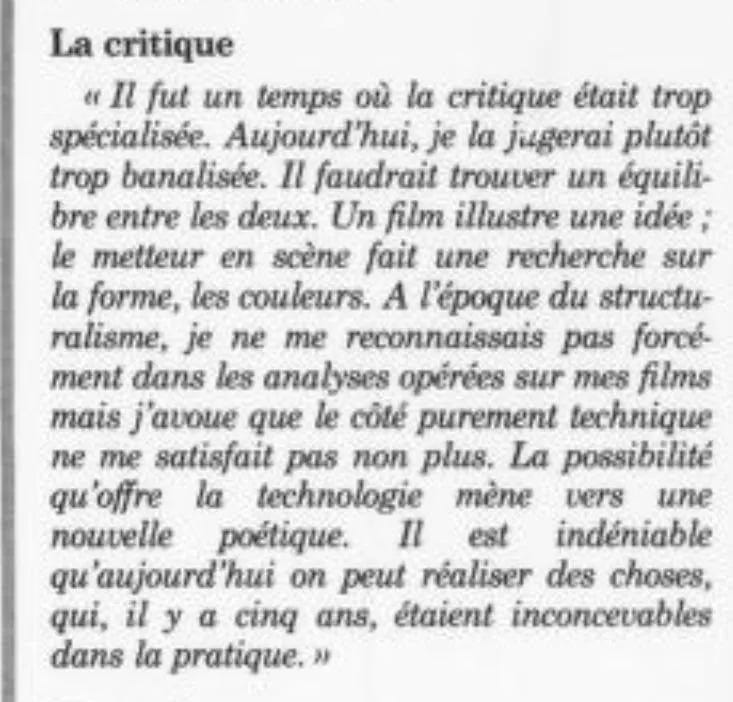
Dario Argento, 1986:
There was a time when film criticism was overly specialized. Today, I would consider it rather overly trivialized. A balance between the two needs to be found. A film illustrates an idea: the director conducts research on form and colors. During the height of structuralism, I didn’t necessarily recognize myself in the analyses made of my films, but I admit that the purely technical side didn’t satisfy me either. The possibilities offered by technology point toward a new poetics. It is undeniable that today we can accomplish things that, five years ago, were practically inconceivable.
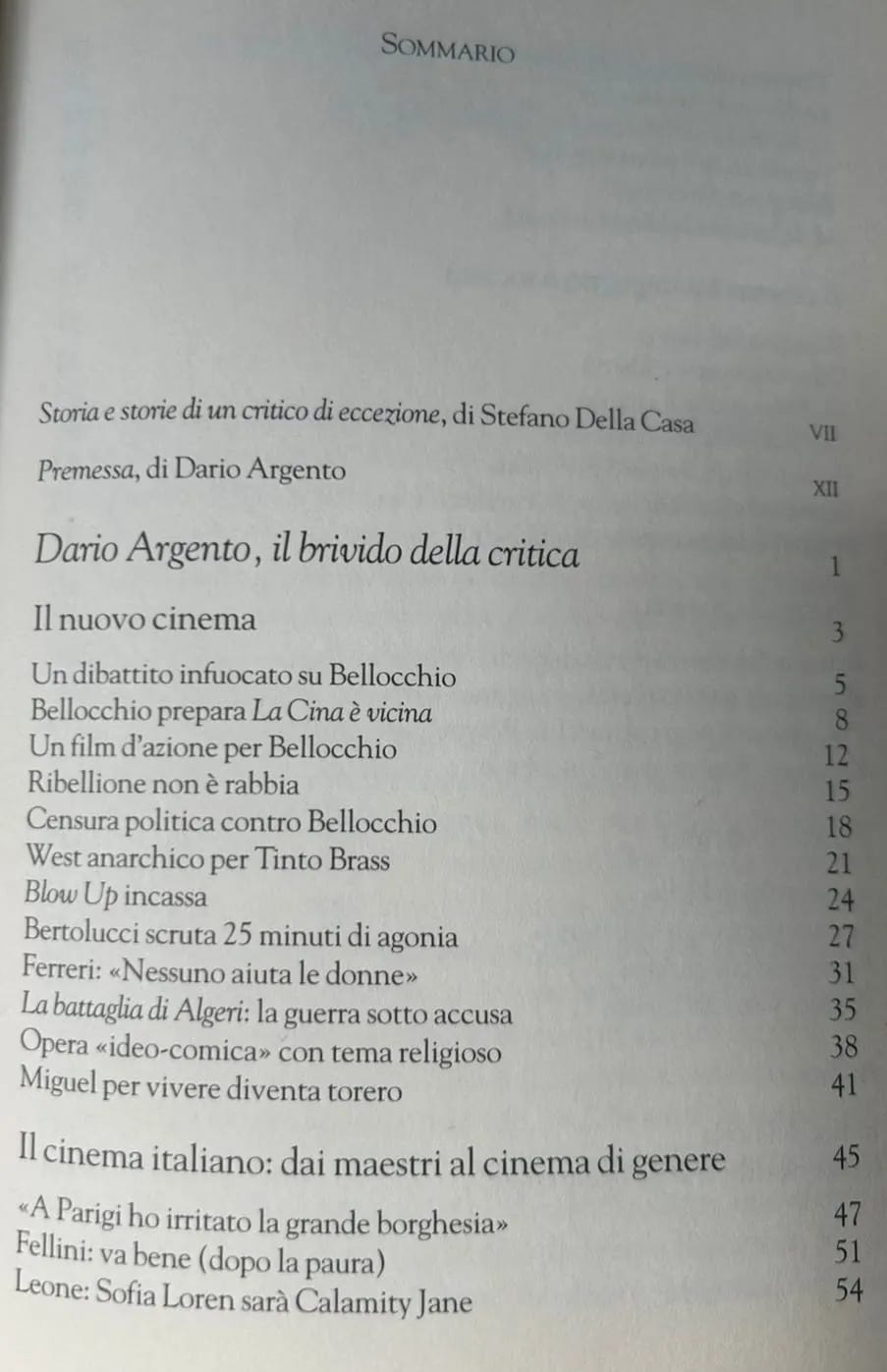
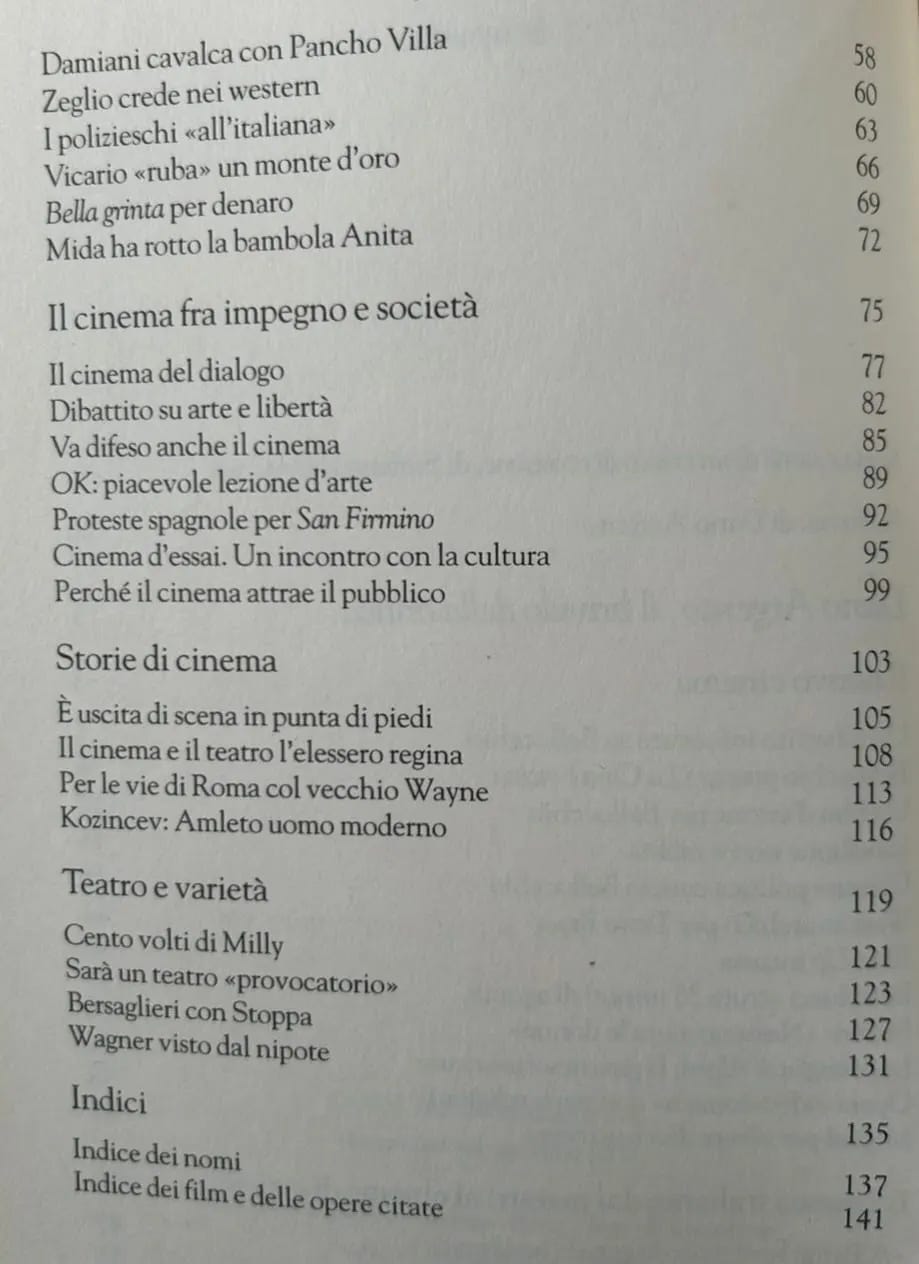
Table of contents for the book Dario Argento, il brivido della critica, a compilation of critical texts written by Dario Argento during the 1960s.
(Excerpt from Dario Argento: Soupirs dans un corridor lointain)
I believe I haven’t changed much. I believe my life has remained the same, with all the difficulties encountered along the way. But I am... In reality, my thoughts are the same, my reading habits are the same, the cinema I love is the same. I believe I haven’t changed much.
Argento turned 86 on September 7th of this year.
A living giant of Italian cinema—“avant-garde popular art,” as Eduardo Savella wrote in an essay for Foco.
--------------------
A recent post—and also connected to what Costa recently said about cinema confronting reality:
As I mentioned to Gustavo, a scene that could only exist in an Italian film. Even in an Argento film.
And speaking with Thiago Vasconcelos earlier: a task to undertake throughout the course—after going through Hitchcock, Lang, Bava, Tourneur, Antonioni, Nuovo Cinema, Resnais (another filmmaker whose work will be linked to Argento’s in the course), De Palma, Bergman, Soavi, etc.—is to arrive at Laurent Achard, and Dernière séance in particular: the only film and filmmaker I know that place Argento and Paul Vecchiali along the same line of development of forms (Once More released a year after Opera, and shot in the same year as Argento’s film), which is that of the critical-reflective posterity of Pasolini’s cinema of poetry.
In the past, back when I was still a film critic, I led a debate with Pasolini—I moderated it—where Pasolini answered questions from the audience. And I asked him something, since he had written an essay in which he said there were two types of cinema, the cinema of prose and the cinema of poetry. The cinema of prose is the one where you never see the camera. The cinema of poetry is the one where the camera is very present. So I asked him—and since he was a poet, I thought he would answer me differently... I asked: “What kind of films do you make? Prose or poetry?” And he said: “I make a cinema of prose, because in my films you never see the camera.” So, when I started making movies, I realized that I was making a cinema of poetry, where the camera is very present.
Luciano Tovoli explains the shot from Tenebre (1982) with the Louma crane moving around Villa Ronconi.
Excerpt from Dario Argento’s World of Horror (Michele Soavi, 1985).
Brian Eno, one of the composers of the soundtrack to Opera:
In cinema, music is generally used to emphasize what you are seeing. It provides the same information. It’s like telling the same story twice. What I try to do is something else. The music should run parallel to the story we see — sometimes joining it, and at other times separating from it. Music adds new affects and perceptions to the film. It is not there simply to confirm what you are seeing.
— That fury present in Argento up until Opera cooled down a bit and transformed. What do you think happened? What changed in Dario at the end of the 1980s?
— First of all, in Opera there was a major jump in budget. Dario even brought in an Oscar-winning director of photography, Ronnie Taylor. Those were times when Dario envisioned a dolly suspended from the ceiling of the Teatro Regio in Parma, descending slowly with a remote-controlled camera to simulate a crow’s subjective point-of-view. Those were the kinds of things that took three weeks to build—with testing and everything else—and then only half-worked, or didn’t work quite right. Those were times when things like that could still be done. Then came a point when the kind of cinema we were making—shot in English, casting an American actor or actress, creating these international products—ceased to exist, stopped working.
LUIGI COZZI: The key is television. Television has financed all Italian cinema ever since. But it was no longer the Italian cinema of before. It was an Italian cinema made for television, produced under television’s conditions. Among these conditions, there is one stating that if a film receives a restrictive age rating, it must return all the money provided for its production. This transformed cinema, as authors were no longer free to express their imagination as they wished.
LAMBERTO BAVA: Dario always replies: “We made that kind of cinema; then, that kind of cinema was transformed.”
MICHELE SOAVI: It’s nobody’s fault; the fault lies with the market. A point came where there was simply no demand anymore.